Showing posts with label Taisho. Show all posts

Wednesday, June 25, 2014

描かれたチャイナドレス Chinese Style Dresses at the Bridgestone Museum of Art

Museum exterior.

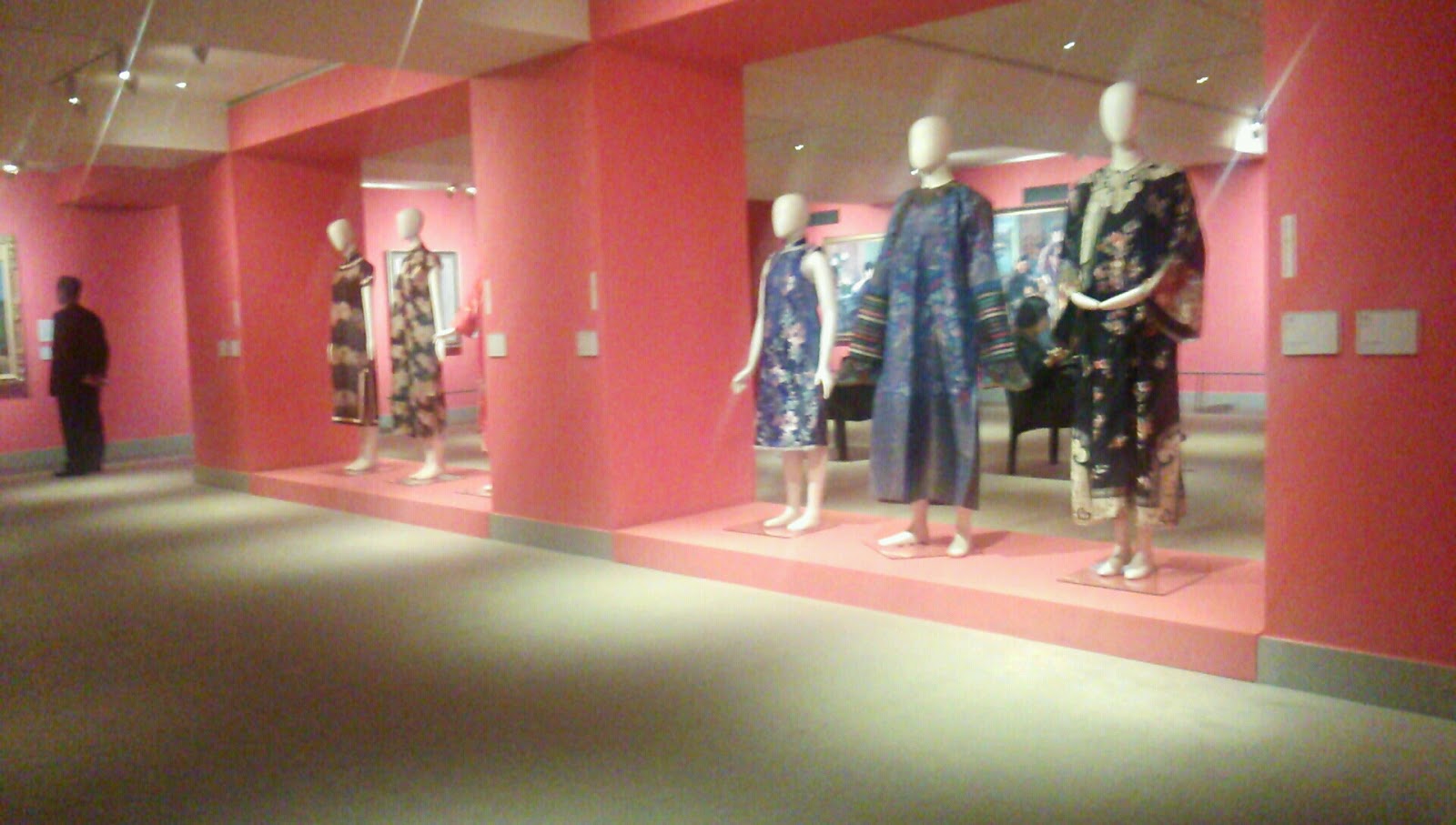
After all the work of the past few weeks, there are a few exhibitions around Tokyo that I want to catch up on, so on Wednesday I started into doing just that by heading to the Bridgestone Museum of Art to see Chinese Style Dresses. The exhibition included paintings of women dressed in Chinese style clothing, as produced by Japanese artists between 1910 and 1940. This is a fascinating group of artworks that address issues of gender, colonialism, orientalism, power, and fashion in what was a tumultuous time in Asia. The Taisho period saw a boom of interest in things Chinese, much of which was linked to the new Japanese colonies of Taiwan and Manchuria. Seeing these fascinating paintings together in two large galleries, and accompanied by a small showing of historic costumes was truly a treat.
 
Gallery one. Kume Tamijuro's Chinese Dance from 1920 is visible at the left. This painting is my new obsession. 
 
Gallery two- historic costume juxtaposed with the paintings.
 
The catalogue!   

Friday, June 06, 2014

Kayaba Coffee カヤバ珈琲


This is Kayaba Coffee.  It's located not far from the research institute in a neat little neighborhood between Nippori and Nezu stations, and close to Tokyo University of the Arts and the well-known gallery SCAI The Bathhouse. I've been meaning to post an ode-to-Kayaba Coffee for a while now, but finally got some decent photos to do so with. The building was constructed during the Taisho period (I believe 1917), but didn't become a coffee shop until the late 1930s. They serve great coffee and fantastic matcha cake, as well as a changing daily menu. I've only been for lunch, but it is always something light and healthy with lots of veggies. There are usually three options, plus the standard sandwiches. It is affordable, but it really feels like somewhere special-I always leave having had a great conversation and a fantastic meal.
 

Thursday, December 19, 2013

Bunka Gakuen Costume Museum 文化学園服飾博物館

Museum exterior.

 Today I headed down to Shinjuku to view the exhibition, Imperial Court Costumes of the Meiji, Taisho, and Pre-War Showa Era at the Bunka Gakuen Costume Museum. The museum had two large galleries, and an amazing mosaic of 1920s fashions installed in the lobby. The exhibition that I viewed covered court costume between the 1880s and 1990s, and contained men's military and ritual costumes as well as formal women's dresses in European styles of the late 19th and early 20th centuries, and women's ritual costumes. The clothing was impeccably constructed, and the fabrics lush and impossibly luxe. Some of the women's European style dresses had amazingly detailed beading and embroidery, and the women's ritual costumes were constructed of more than ten layers of finely woven silk.

While it's one thing to view these types of dresses as artworks, and easy to desire such beautiful things for one's self, I think it would be quite another thing to have to wear them regularly. The photographs of the women in their lovely wears that accompanied the costumes didn't really exude a feeling of comfort, joy, or fairy tale. This is something I'm constantly thinking about in my own research- the members of the imperial family didn't really (and don't still) have much control over their own lives. Rather, they were (and are) representatives of the nation, and as such we can't really know who they were as individuals. Sure, they have seemingly infinite resources and material possessions that many look upon with envy, but they are also limited in their personal choices (career, marriage, social circles, etc.). Contemporary society has constructed a princess narrative that we sell to young girls and women in the form of Disney princesses and fairy tale weddings, but the reality of the lives of royalty doesn't really seem to me like something to envy. So where do we draw the line between an escapist have-it-all princess fantasy and a consideration of the reality? Is there harm in the princess narrative? Certainly I think the princess wedding is a cultural institution that we could do without, but what about for young girls? Shouldn't we be empowering them with realistic choices instead of fantasies of palaces and pretty dresses? As a mother of a little boy I am so grateful that I don't have to navigate that minefield of feminist issues within my own family, but I do think that we as a society need to consider the messages we are relating to women and girls.
 
The cover of the catalogue- beautiful things contained within!
 
 Walking through Shinjuku on the way back to the station. 

Wednesday, November 27, 2013

Japanese Christmas

1920s Santa is in a rush in his wacky polka-dot-pjs! Thumbs up!

Well, it's the day before Thanksgiving. The holiday doesn't mean much here in Japan, but it does make me a little homesick to see all of my friends posting things to the internet about meals, travel, and break. I have a few things planned for tomorrow and the weekend, and have enjoyed reading the NPR Project Expat series this week, so my favorite holiday of the year will definitely not go without notice.

While Thanksgiving is virtually non-existant, Christmas is a secular holiday here in Japan, something celebrated the way Americans celebrate Valentines Day or Halloween- good, fluffy fun. I'll post more about it in the coming weeks, but decided to start my own Japanese Christmas season today. In the midst of combing through 1920s newspapers this afternoon for my research, I came across an amazing 1921 advertisement for Christmas decorations at a Ginza department store, complete with cocoa served at the store (above). I took it as a sign that my own holiday season should start today, despite my usual hard line against anything Christmas before Black Friday. So, this evening, I got out the decorations that I bought at the 100 Yen store a few weeks back.
 
Five dollar Christmas!

I turned to YouTube, and selected a Christmas music mix with a fireplace video. Amazing!
 
Ah, modern life.

I poured a glass of wine, and about 15 minutes later it's Christmas in my Tokyo apartment! Yay!
 
Cheers! 

Saturday, November 23, 2013

Kiyosumi Gardens 清澄庭園


Today I took a trip over to the east side of Tokyo to visit the Kiyosumi Gardens. The site of the garden dates back to an 18th century residence of a wealthy Edo (the previous name of Tokyo) businessman, but the current design dates to the late 19th century. The reason for my visit is that the funeral hall of Emperor Taisho (r. 1912-1926) was located here, until it was destroyed during the Second World War. The garden does presently house the Taisho Kinenkan (Taisho Memorial Hall), which is a 1953 reconstruction of the emperor's hall, but using the materials of his wife's funeral hall. In addition to my academic interest in the garden, it was also a lovely autumn day, and visiting the garden was a great excuse to go for a stroll in a beautiful park, escaping some of the bustle of Tokyo for more serene landscapes.

 One of the many boulders at the site- gathered from all over the country to give the garden character.

 Entering the garden!

 Rocks and trees and water. 

 Me and the Taisho Kinenkan (Taisho Memorial Hall).

 Scenic. 

The park is known as a place to view not just the scenery, but also to see fish, turtles, and birds. The koi in the central pond were particularly huge, and both the fish and the birds were crazy for the little breadcrumbs that visitors were feeding them.

 Koi. So creepy when they open their giant mouths.

 Getting a little Hitchcock vibe from the birds swarming the breadcrumbs.

Taisho Kinenkan again.

 Scenic!

 The ginkgo leaves were particularly lovely.

 A small stone pagoda in the garden. 

 Sensui-selfie.

 Leafy.

 I watched this little turtle for quite a while. He was chillin', floatin', and then sunning himself. So cute. 
Such a relaxed way to spend the day. I am learning from the turtle about how to live better.


There was an area of stone Buddhist sculpture near the south end of the park, which was a nice surprise.

 Jizo!

 Oh, no big deal, just throw in some 16th and 17th century sculpture near the back (!).

 Garden view.

 Another garden view.

 Stepping stones.

 Crane! So elegant. I could also use some life lessons from this guy. 
Move slowly, observe a lot, be serene, strike quickly and with purpose when catching fish.

 One last view on the way out.

Next to Kiyosumi Gardens is Kiyosumi Park. While the garden was quite formal and full of people on afternoon dates, older folks taking photos, and families on day trips, the park was full of exuberant life- a toddler learning to walk, high schoolers practicing baton, families picnicking, people walking dogs and dogs barking at each other, people on bikes, kids playing ball. As the sun set between the gingko trees, it was a truly joyful sight.

 Life being lived to the fullest.

Golden afternoon glow.

Monday, October 21, 2013

Tokyo University 東京大学


Today I spent the afternoon at Todai, or Tokyo University.  I met up with a scholar who is a friend of a friend, and she was so kind as to introduce me to a variety of resources on campus that relate to my research, which intersects with hers. The campus is quite lovely, especially on a beautiful early autumn day. Above is the famed Akamon, or Red Gate, which dates to 1827 when the land that the university sits on was part of the estate of a feudal lord.

The building that houses the Historiographical Institute, where I was able to view primary source documents related to my project.
 

Campus scenery.
 

Yasuda Auditorium, built in the 1920s with the intention of representing the of the university, and being grand enough to receive imperial visits.
 

Even the metro stop is green and academic in feel.


Saturday, October 19, 2013

Arakawa Toden 荒川都電


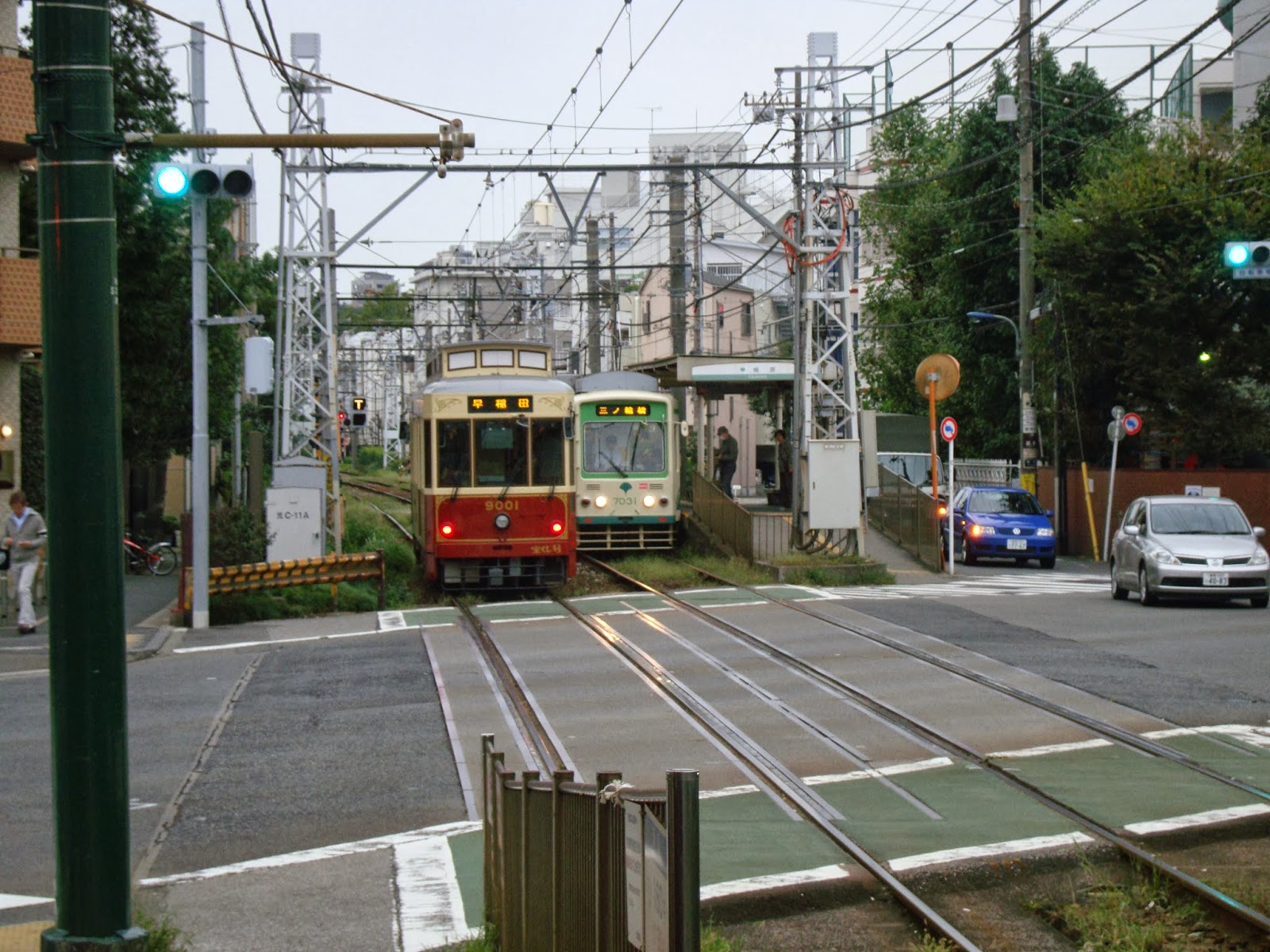
The closest transportation to my apartment is the Toden Arakawa streetcar. I live about a two minute walk from the streetcar stop, so as a result I take it nearly every day, and sometimes multiple times a day, using my monthly pass. There used to be over 41 streetcars in Tokyo, but the Toden Arakawa is one of only two that remain (for a great article on streetcars in Japan click here). I generally take the streetcar to Oji, where I can transfer to the JR lines or the Metro subway system, but sometimes I take it further, as it is inexpensive, and a fun way to see the city.


The Arakawa line runs on its own tracks, sometimes on the street, but mostly on above ground rails with its own right-of-way.


During peak times it runs every 3-5 minutes, and even during off hours, it runs less than 10 minutes between trams. The only problem is that it stops early, around 11:20 p.m., so there have been a few occasions where I've had to walk the 12 minutes from the JR train when coming home late from other parts of Tokyo. Click here for the route map.


Board here. One gets on in the front, scanning a transport card or putting in change, and then exits at the back of the tram.


There are multiple styles of tram


This is my favorite tram style- it is based on the old Taisho period design, but is the newest type of car. The interior is completely wood styled. So beautiful! Also, as my dissertation is on the early twentieth century, I find these trams to be a bit inspiring for my project.


In Kajiwara there is a small Japanese-style bakery that sells Toden Monaka, small wafer sweets filled with bean paste in the shape of the streetcar.


I bought a single monaka, but if one purchases multiples, they come in a box that looks like a train yard.