Sunday, September 08, 2013

Ueno Beer Garden 上野ビァガーデン


One of the great pleasures of summer in Tokyo (or any Japanese city), are the beer gardens that sprout up on rooftops from July through September. Many are located atop department stores, and offer nomihodai, or all-you-can drink for two hours. On Saturday evening, my friend Liz and I went to the Seiyoken Beer Garden located in Ueno Park. Seiyoken is mainly a restaurant and banquet hall, but the beer garden was fantastic- a bit classier than the department store varieties, and with a more relaxed crowd (read: not a rowdy twenty-two year old set). The view over the park was also lovely.
 

Rooftop drinking = classy.
 

The late train home.
 

Friday, September 06, 2013

Waseda Workshop 早稲田ワークショップ


Grabbing a quick iced coffee at the Waseda University coffee shop in between a day at the research institute and attending an evening presentation at the Waseda Modern History Workshop.

Thursday, September 05, 2013

Tuna and Wasabi 鮪とわさび

Today while walking home from an afternoon of working at the coffee shop, I came across a new (to me) grocery store. This is the fancy kind of grocery store- the one with.... wait for it... taco shells, imported cheese, and real salad mix (as in not iceberg lettuce or cabbage slaw). Oh, the joy. I haven't been here quite long enough to be craving such import goods, but I did pick up some fresh tuna for dinner, along with fresh spinach. I stir fried the spinach with garlic, prepared some white rice with shiso furikake, and briefly cooked the tuna with a generous coating of pepper. I then made a light sauce of Japanese mayo and wasabi, with a hint of soy sauce, and grated up some daikon to place under the fish. 

Wednesday, September 04, 2013

Earthquake 地震


This morning as I was talking with the fam on Skype, an earthquake hit. I don't think I will ever get used to this. Today's was a 3 or 4 on the JMA scale, which measures the shaking at any given location, rather than the energy released at the epicenter (like the Richter scale). It was so bizarre to be talking with Joe in KC, as the lamp swayed behind me, and my entire apartment felt like it was a boat on the water. Later today at work I was speaking with a co-worker about the earthquake, and he didn't really give it much thought. He did, however mention how nerve wracking he found this week's Saitama tornado to be, as such weather events are quite rare here. To me, as a Midwesterner, a tornado isn't something to fret about too much, proving that weather events are all relative to one's experience.

Tuesday, September 03, 2013

Musashi Imperial Mausoleum 武蔵陵墓地


Today I took a trip out to the far western reaches of the Tokyo metro area to visit the Musashi Imperial Mausoleum- the burial site of Emperor Showa, Empress Kojun, Emperor Taisho, and Empress Teimei. My tour began at Takao Station, nestled in the mountains near the famous hiking spot, Mt. Takao. I had a lunch of homemade onigiri from a small local shop near the station, and a Takao potato sweet cake, which was pretty tasty.


The north entrance to Takao Station.


The mausoleum was about a mile walk from the station, along a tree-lined street, over a river, and past this lovely area of flowers.


The map of the mausoleum.


The grounds were incredibly beautiful, and a welcome break from the congestion and bustle of Tokyo life.


I first came to the mausoleum of Empress Kojun, wife of Emperor Hirohito. After viewing her grave for a few minutes a very official man in a full suit with a headset came up to me and informed me that Princess Akiko would be visiting soon, so could I please wait near the side of the walkway and put away my cell phone and camera.


I walked over to the designated area, and watched as another man raked the gravel near Emperor Showa's tomb, and placed a few ceremonial objects on a table beneath a small tent (below). At this point a formal navy blue car pulled up and the Princess emerged. She walked up to the tomb, bowing deeply before each  set of stairs. I couldn't see what she did up near the base of the mausoleum, but she then walked over to Empress Kojun's tomb and did a similar ritual. She then got back into the car and pulled away, never making eye contact with me and the other three regular folks who happened to be there. Two of the other people bowed very deeply as she passed, the other refrained from doing so. Even if she isn't in line for the throne, it was pretty exciting to see royalty from about twenty feet away, especially considering that her great-grandmother was Empress Teimei, the subject of my dissertation (click here for the genealogy of the Imperial Family.


Another shot of Emperor Showa's tomb.


It was about a three minute walk over to the mausoleum of Empress Teimei.


Me in front of  Teimei's tomb.


It was interesting to see the different designs and plans amongst the four tombs at the site, for example, Emperor Taisho and Empress Teimei's tombs were much more wooded and located higher on the hill than Emperor Showa and Empress Kojun. The site will likely remain the same for the foreseeable future, as Emperor Akihito has expressed his desire to be cremated.


The stone plaque marking Empress Teimei's tomb.


Emperor Taisho's tomb.


After my visit, I walked back to the station, taking in the beautiful mountain scenery along the way.


Flowers near the river.


Waiting for the train back to Tokyo at the end of the day.


Monday, September 02, 2013

Uguisudani 鶯谷


On days when I go into work at the research institute, I have a lovely ten minute walk from Uguisudani Station. I took these photos on my way home, as it was pretty sizzling hot when I was making my way in. The walk includes a clear view of the Tokyo Sky Tree, a relatively new landmark, but at 634 meters (2,000 feet!) one that can bee seen from most places on my side of town.
 

Most of the walk skirts the north side of Ueno Park, between the trees of the park and the cemetery which sits across the street. The wooden plaques of the graveyard can be seen in the first photo, and beyond the wall below. The huge crows that make the park their home are also a constant feature. 
 

I also pass the gate of the mausoleum of Tokugawa Ietsuna, who ruled from 1651 to 1680.
 

After walking past a taxi waiting area and a middle school, I arrive at Uguisudani.
 

Sunday, September 01, 2013

王子狐 Oji Foxes


On Sunday afternoon I was working on some reading at a coffee shop near Oji Station, a bustling area relatively close to my apartment. When I left, I walked out into the streets to find a parade of foxes. 
 

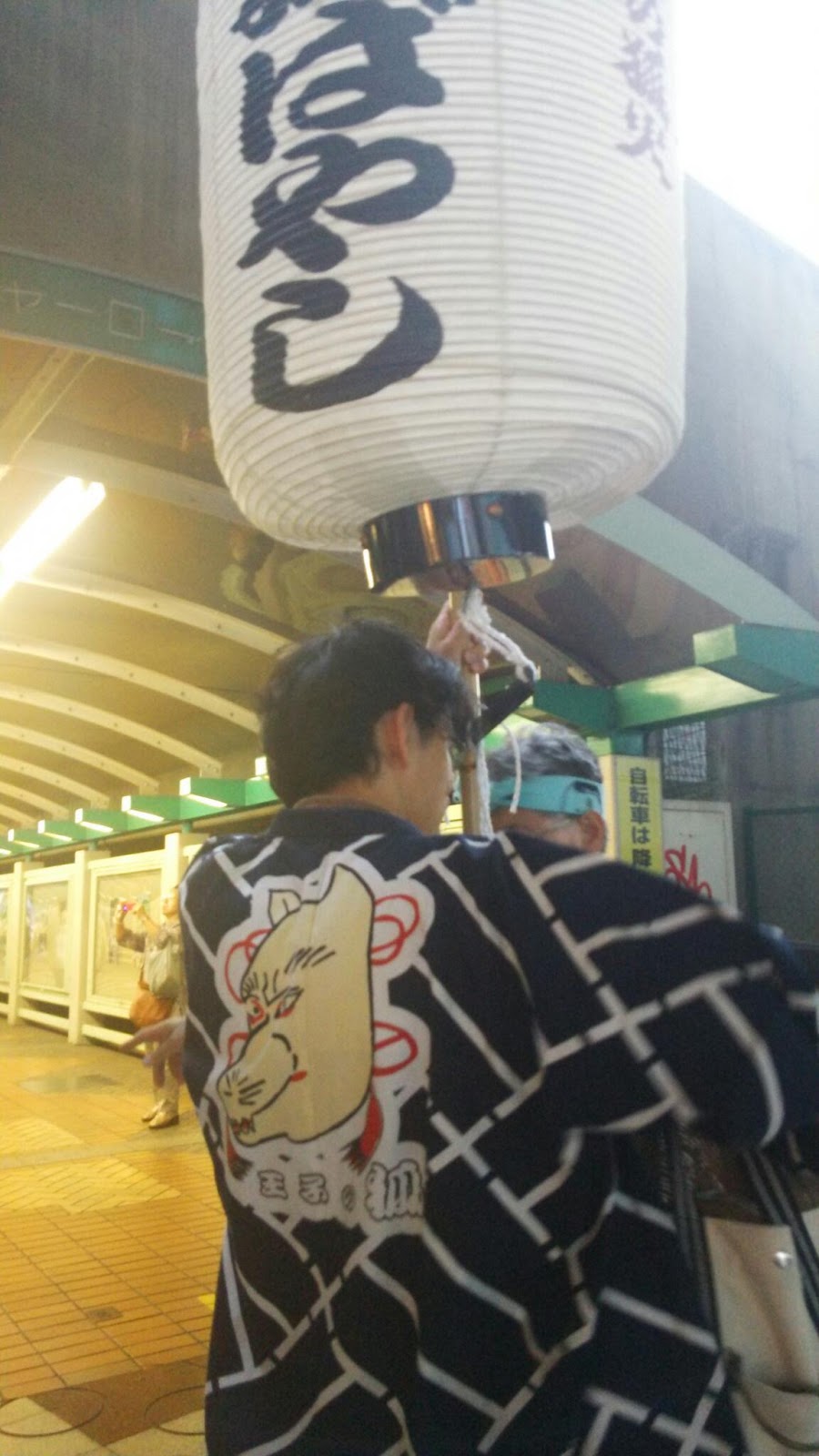
Elaborately costumed foxes, kiddos as foxes, regular folks with fox masks, and music to accompany it all. 
 

Masses of people in yukata with fox masks.
 

The most elaborate of the foxes.
 

The kids who played drums and flute to accompany the parade.
 

I looked up "oji fox" when I got home, and found out that Oji Shrine, which is fairly close to the station, is a famous gathering spot for kitsune (foxes) on New Year's. At that time there is a big parade starting at midnight- something I'm now looking forward to. I knew the image of foxes gathering from the Edo period Hiroshige print of the subject, but hadn't put it together that my neighborhood Oji was the same Oji of Hiroshige's landscapes.  As it looked like impending rain, I didn't follow Sunday's fox parade up to the shrine, but definitely have a shrine visit on my list of things to do.
 

Meiji Shrine 明治神宮


Early on Sunday morning I met up with a friend and her family who are in Tokyo for vacation this week. Despite the heat, we hit up the Meiji Shrine, walking through the verdant grounds, and viewing the shrine where Emperor Meiji (ruled- 1868-1912) and Empress Shoken are memorialized.


Before entering the main part of the shrine, we all received omikuji, or fortunes. Each was a poem written by either Emperor Meiji or Empress Shoken. Mine was written by Empress Shoken and read:

Cut, if need be, through thick briars,
Knots of brambles, tangled thorns,
For the path that's yours to follow
Must be trodden to the end.

It was interpreted as:

Never turn aside from the road that your convictions tell you to follow, whatever obstacles you must surmount on the way. Be true to yourself.

I love this fortune. Not only was it written by the empress (the following empress, Empress Teimei, is the subject of my dissertation), but it is about persevering and taking the path less traveled, much like my current situation. While I'm not a religious person, it does feel like fate intervened to give me such an appropriate verse.

We also viewed the wish plaques, and saw a Shinto wedding taking place at the shrine.


In addition to the shrine itself, we visited the Treasure House and Treasure House Annex, seeing clothing and other objects used by the emperor and empress themselves (below).


After walking around the shrine, we stopped for lunch in Harajuku, which was bustling on a Sunday afternoon.


Luxury 贅沢


As part of Thursday's adventures around the posh part of town, we came across some rather expensive goods. First off, $126 grapes in the lobby of the Mandarin Oriental Hotel. Yep, you read that right. There were also $300 melons in the same shop. And $30 bottles of juice. Definitely not within my budget, but still beautiful to see. Sadly, no free samples. We also spied these geometric watermelons- sans price tag, and $30 single peaches. This is not to say that all of Tokyo is so expensive- the grapes at my local market range around $4-6 a bunch, and peaches run about $1 each, sometimes $3 for the more desirable varieties.


In our wanderings we also ended up in the lobby of the giant Mitsukoshi Department Store (below). The store has its origins in a 17th century kimono shop (1673 to be exact), and the Nihonbashi location is particularly luxurious. We saw a weaving demonstration in the lobby, complete with gorgeous handcrafted obi (kimono sash) for sale.... starting at $10,000. Needless to say, we were starkly reminded that we are living in the most expensive city on the planet, and as such grabbed some small pastries from one of the basement food stalls and headed over to a public park.